Borrow Like a Billionaire: Spout Founder Marc on Bringing 0% Interest Trading On Chain
In this episode of The Blockopedia podcast, Spout co founder and CEO Marc sat down with The Blockopedia co founder Mohammad Ahmad Khan to talk about leaving investment banking for crypto, why tokenized stocks alone are not the real unlock, and how Spout is trying to give retail traders access to a borrowing structure once reserved for billionaires.
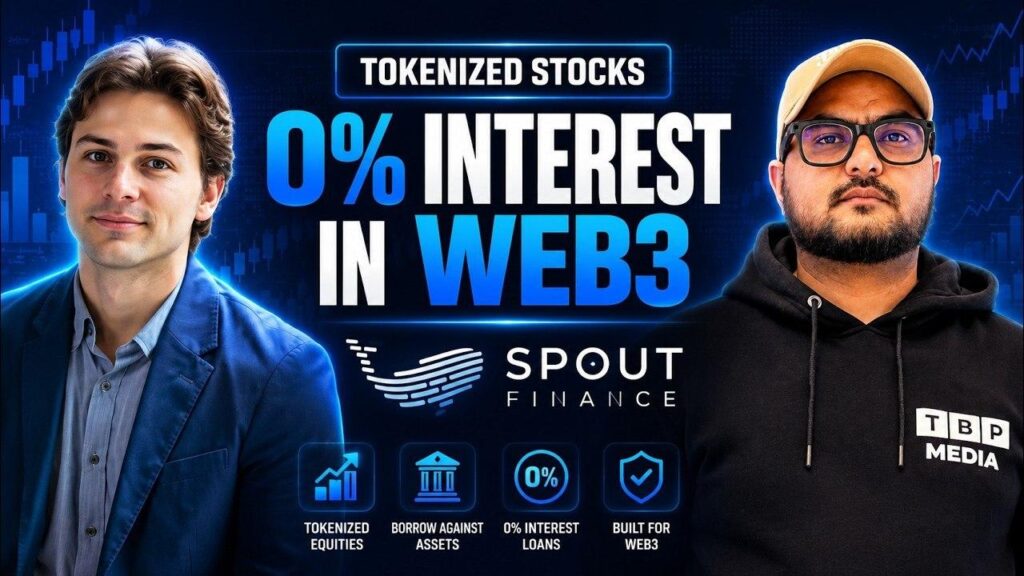
In this episode of The Blockopedia podcast, Spout co founder and CEO Marc sat down with The Blockopedia co founder Mohammad Ahmad Khan to talk about leaving investment banking for crypto, why tokenized stocks alone are not the real unlock, and how Spout is trying to give retail traders access to a borrowing structure once reserved for billionaires.
Marc‘s path into crypto started the way it did for a lot of people in 2017, watching classmates trade during the ICO craze and deciding he had to get in himself. That curiosity carried through DeFi summer, a pile of now worthless NFTs, and eventually into a TMT investment banking career where he worked on deals like the ARM IPO while quietly funneling income into crypto side bets. After a few years, he left banking to build full time, meeting his future collaborators through an Aptos accelerator program before eventually landing on the idea that became Spout.
Why Tokenization Alone Isn’t the Real Unlock
Marc’s core thesis is straightforward but sharp: simply wrapping a stock as a token doesn’t create meaningful new value, since anyone with capital can already open a brokerage account and trade the underlying asset directly. The real opportunity, he argued, is doing something on chain that traditional finance structurally cannot offer off chain. For Spout, that means running an investment strategy on deposited equities to subsidize lender returns, allowing the platform to offer 0% interest borrowing against stocks, a structure normally reserved for large institutions and ultra high net worth clients through prime brokerage arrangements.
From Flip Vault to Spout
Before Spout, Marc built Flip Vault, a peer to peer liquidity sourcing platform aimed at reducing cross chain bridging fees. He eventually stepped away from it after concluding the revenue model was a race to the bottom, with little defensible moat once other platforms could copy the infrastructure. That experience shaped how deliberately he approached Spout’s positioning around a harder to replicate financial structure rather than pure infrastructure plumbing.
Managing Risk Like TradFi, Not Like Crypto
Marc was candid about the tail risk built into lending against equities, particularly around after hours price gaps that could expose lenders to sudden losses. Spout’s answer borrows directly from traditional finance: an insurance fund, a protocol treasury, and a tranching system that separates senior and junior risk, so junior tranche holders absorb losses first in exchange for higher yield. He framed this explicitly as importing structures that exist off chain for good reason, rather than the looser experimentation he sees across much of DeFi that tends to work until a black swan event wipes it out.
Why Real Time Pricing Is Harder Than It Looks
Unlike Bitcoin or Solana, which trade continuously with deep liquidity, equities still have relatively thin price discovery even during extended trading hours. Marc explained that this thinness makes some platforms’ push toward 24/7 equity trading riskier than it appears, since liquid names like Apple could still swing unpredictably after hours and trigger liquidations that shouldn’t happen. Spout is deliberately holding off on expanding beyond standard market hours until the underlying infrastructure matures.
Choosing Solana Over Ethereum L2s
Marc’s reasoning for building on Solana centered on avoiding fragmentation. Rather than betting on an Ethereum layer two that could become obsolete if Ethereum mainnet eventually scales the way Vitalik Buterin has suggested it will, he preferred Solana’s single chain design, along with what he sees as the ecosystem’s growing seriousness around real world assets and institutional infrastructure rather than purely retail speculation.
What the Testnet Is Really For
Spout’s testnet, launching soon, is less about generating flashy signup numbers and more about tracking real user behavior, where people get confused, which explanations need simplifying, and where the product might feel too good to be true without enough context. Marc expects the feedback quality to improve further once private beta mainnet goes live with real capital at stake, since he says user behavior shifts meaningfully once actual money is on the line.
Milestones Worth Watching
Beyond the testnet, Marc pointed to total value locked from both borrowers and lenders, plus a growing list of equity integrations including Ondo, xStocks, Binance’s stock offering, and Dinari’s dShares, as the clearest signals of Spout’s traction. Conversations are also underway to offer Spout’s lending and borrowing directly through centralized exchanges, though he declined to share specifics before anything is finalized.
Raising Capital in a Crowded Tokenization Market
Marc said the investors who understood Spout’s pitch immediately were the ones who already recognized that tokenization infrastructure alone has become saturated, with players like Securitize, Ondo and Backpack all competing for the same narrow slice of volume. The harder conversations, he said, came from investors too firmly rooted in either pure TradFi or pure DeFi thinking to grasp a product deliberately built in the overlap between both worlds.
Watch the full conversation: https://www.youtube.com/watch?v=0BKtSmra3hI